HOME → Dragon Plastic Model Kits → 1/35 Military → 6997

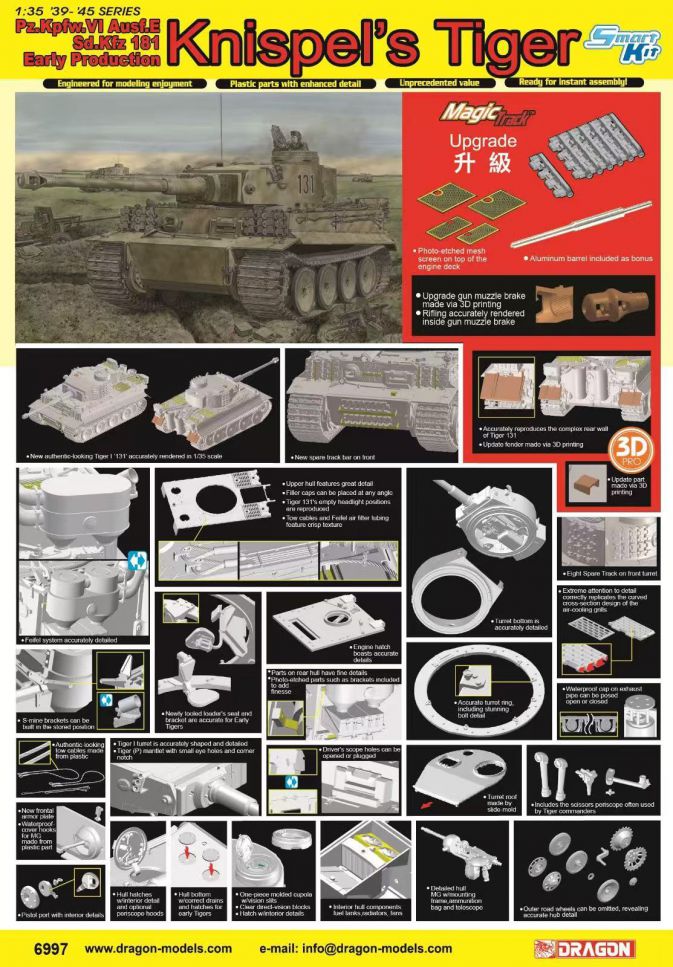
Kit Introduction – 1/35 Pz.Kpfw. VI Ausf.E Sd.Kfz. 181 Early Production – “KK’s Tiger I”
Tiger I No.131 – Kurt Knispel’s Tiger
Dragon Models Item No. 6997
Kurt Knispel is one of the most legendary figures in Panzer history — and paradoxically, one of the most elusive. Despite being credited as the highest-scoring tank ace of the Second World War, remarkably little solid, verifiable information survives about the specific vehicles he served in. Unlike some of his contemporaries, Knispel left behind no memoirs, and wartime documentation linking him conclusively to individual Tigers is scarce. Over the decades, several Tigers have been attributed to Knispel. A well-known photograph shows him posing beside Tiger “101”, but closer examination reveals that this vehicle belonged to his company commander and was used for a newspaper photograph. Other claims, including those found in post-war popular histories, place him in different Tigers, but these accounts rely on sources that are no longer considered reliable by modern historians.
Separating Myth from Evidence
The only Tiger that can be reliably and historically associated with Kurt Knispel is Tiger I No.131 of schwere Panzer-Abteilung 503. This conclusion is based on a first-hand battle account written by Hauptfeldwebel Horst Haase, preserved in the battalion’s memoirs. During a combat operation in 1943, Haase temporarily assumed command of Tiger No.131 when its commander, Fendesack, fell ill. In his account, Haase recalls the names of the crew — including the gunner: Unteroffizier Kurt Knispel. Over the course of two days of intense fighting against Soviet T-34s, Tiger No.131 engaged enemy armor repeatedly, sometimes operating alongside another Tiger. According to Haase’s testimony, Knispel destroyed sixteen enemy tanks, halting only when the Tiger’s gun itself was struck. This documented engagement provides the only firm, primary-source link between Kurt Knispel and a specific Tiger I — making Tiger No.131 uniquely significant. Fortunately, this vehicle is also exceptionally well documented in period photographs, allowing for an unusually high level of historical and technical accuracy.
A Year of Research, Built on Decades of Expertise
Dragon’s Tiger I: Kurt’s Tiger is the result of more than one year of focused research and development, led by David Byrden, widely regarded as the world’s foremost authority on the Tiger I tank. David Byrden, B.Eng., began his study of the Tiger in 1990 while attempting to super-detail a model kit interior. His work soon went far beyond modeling when he was granted rare access to examine the Tank Museum’s Tiger No.131 during a partial disassembly. Through collaboration with renowned historian Hilary Doyle, and access to original factory drawings, Byrden uncovered critical design details that had been misunderstood for decades — including the Tiger’s asymmetrical turret geometry. In 2000, Byrden launched a technical website to publish his findings freely, reshaping how historians and modelers alike understand the Tiger I. Since 2005, he has served as a historical and technical consultant to Dragon Models, contributing to multiple publications and numerous highly regarded Tiger kits. Item No.6997 represents Byrden’s most recent Tiger project, and arguably his most historically restrained and precise. Every detail reflects a careful balance between what is known, what is uncertain, and what can be conclusively proven.
Accuracy Without Speculation
Rather than embellish Knispel’s legend, Dragon and David Byrden chose a more difficult path: absolute fidelity to evidence. Tiger No.131 is reproduced as accurately as surviving documentation allows — no assumptions, no composites, no mythology. This philosophy lies at the heart of Dragon Models’ research-driven approach: to respect history as it was, not as we wish it to be. Tiger I: Kurt’s Tiger (No.6997) stands not only as a tribute to one of history’s most skilled tank gunners, but as a testament to what careful scholarship, primary sources, and decades of technical expertise can achieve when accuracy comes first. .
This release brings together Dragon’s “dream team” — Byrden’s research, Volstad’s visuals, and our own heritage tooling — to recreate one of the most historically important tanks of WWII, as it appeared under the command of its most storied crew.
ITEM NUMBER:
6997
SCALE:
1:35
BARCODE:
089195869975
RELEASE DATE:
October 2025
LAST UPDATE:
10/3/2025
SERIES:
1/35 Military
3538